the woman behind the wallpaper
The Yellow Wall PaperThe woman behind the wallpaper is the trapped figure the narrator increasingly sees beneath the patterned walls of the upstairs nursery. First a dim shape, then a woman struggling against bars, she becomes the object of the narrator’s attention and the imagined companion in her attack on the paper. Her emergence gives visible form to the story’s confinement: the narrator’s account never establishes an independent woman inside the wall, but its final actions make the figure’s escape and the narrator’s own entrapment difficult to separate.
Identity and First Appearance
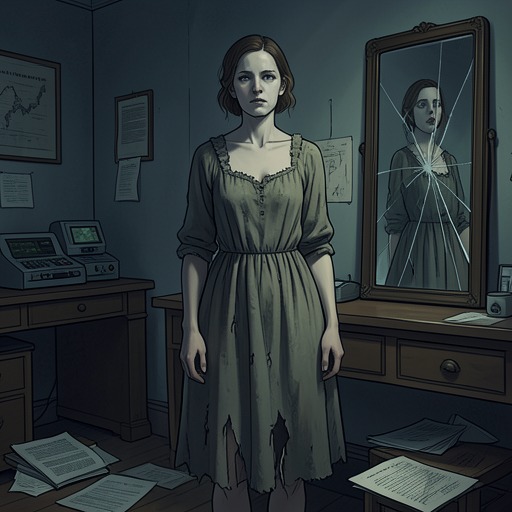
The figure appears as the narrator watches the yellow wallpaper in the room where she and John have come for her rest. The narrator had wanted a downstairs room opening onto the piazza, with roses at the window; John rejects that choice, explaining that the room has only one window and cannot accommodate two beds, with no nearby room for him. Instead, they take the large nursery at the top of the house, chosen for the air and light that John says she needs. Its windows are barred for children, and rings remain fixed in the walls. The setting makes the later image of a woman behind bars part of a room already marked by restrictions on movement.
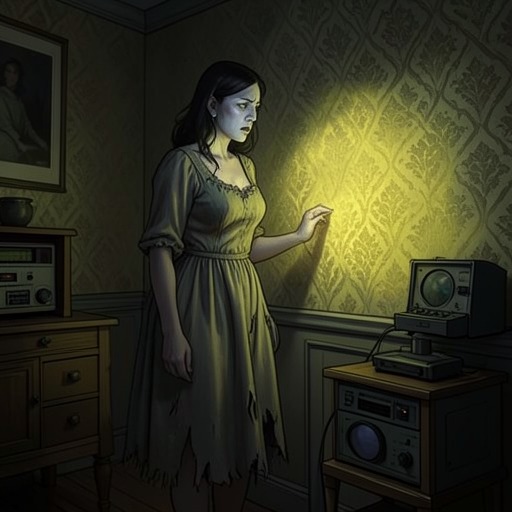
At first, the woman is not clearly distinguishable. The shapes behind the outside pattern grow clearer day by day, but the narrator describes them as numerous instances of one recurring form. She compares what she sees to a woman stooping and creeping behind the design, and says she wishes John would take her away. The figure thus enters the account at the point where the narrator’s close observation of the wallpaper becomes fear and a request to leave the house.
The Pattern as a Prison
The figure becomes most distinct under changing light. In twilight, candlelight, lamplight, and especially moonlight, the outside pattern turns into bars, while the woman behind it becomes plain to the narrator. By daylight, she seems quiet and subdued; the narrator imagines that the pattern itself keeps her still. The contrast makes the wallpaper appear to alternate between decorative surface and enclosure, with the woman’s visibility and apparent freedom governed by light.
The narrator then interprets movement in the pattern as the woman’s own action: the front design moves because the woman shakes it. Sometimes the narrator thinks there are many women behind it, sometimes only one; the woman crawls quickly, shaking the paper as she moves. In bright places she stays still, while in shady places she grips the bars and shakes them. These shifting impressions enlarge the figure from a single concealed presence into a possible multitude, without resolving whether the narrator is seeing one woman or many.
The woman is continually trying to climb through, but the pattern seems to strangle anyone who attempts it. The narrator imagines heads caught and turned upside down, with whitened eyes, and concludes that the pattern’s constricting design accounts for their number. In this account, escape is not simply blocked: the wallpaper appears to seize and deform those who press against it. The figure’s struggle therefore gives the narrator a way to describe both the pattern’s visual violence and the repeated effort to get free.
The Narrator’s Recognition and Identification
The narrator’s attention to the figure is bound to the physical traces in the room. Near the mopboard, a long, even mark runs around the walls and behind the furniture, stopping at the heavy bed. She cannot tell how it was made or by whom, but its repeated circuit makes her dizzy. The mark does not prove who moved through the room; within the narrator’s account, however, it sits beside the creeping woman and the wallpaper’s constricting pattern as another sign of repeated movement.
The narrator imagines seeing the woman creep along a road beneath trees and hide beneath blackberry vines when a carriage approaches. She says she does not blame her for hiding, since being caught creeping in daylight would be humiliating. She also reports that she locks the door whenever she herself creeps by day, because she cannot do so at night without John suspecting something. The imagined woman’s concealment and the narrator’s own secret movements run in parallel: both are described as creeping, and both are shaped by the risk of being seen.
This resemblance becomes explicit when the narrator wonders whether all the creeping women come out of the wallpaper as she did. The remark does not settle whether she believes herself literally to have emerged from it or is speaking through the identity she has constructed with the trapped figure. It does show that the distinction between watcher and watched has become unstable. The woman is no longer merely an object in the wallpaper: she offers the narrator a figure through which to understand her own confinement and movement.
Tearing the Paper and the Uncertain Escape
The narrator’s imagined collaboration becomes an action during John’s absence. When Jennie proposes sleeping with her, the narrator says that she will rest better alone. Once it is moonlight and the woman begins to crawl and shake the pattern, the narrator gets up to help. She pulls while the woman shakes, then shakes while the woman pulls; before morning they have stripped away yards of paper, including a strip as high as the narrator’s head and extending halfway around the room. The narrator describes the removal as shared work, turning the figure’s struggle against the bars into a joint assault on the surface that contains her.
On the final day, the narrator locks the door and throws the key down into the front path. She says she wants no one to enter or make her leave before John returns, and that she wants to astonish him. The woman’s supposed escape is thus staged in a room the narrator has deliberately sealed. The narrator also has a rope, hidden well enough that Jennie has not found it, which she says she can use to tie the woman if she gets out and tries to run away. The rope makes her role in the scene double: she assists the escape while also preparing to restrain the person she imagines escaping.
The heavy bed frustrates the narrator’s attempt to move it. She pushes and lifts until she is lame, bites a piece from one corner in anger, and then tears away all the paper she can reach from the floor. The wallpaper sticks fast, and she imagines that its pattern takes pleasure in resisting her; the strangled heads and bulbous eyes seem to deride her. These details keep the final struggle attached to the room’s stubborn material objects rather than allowing escape to remain only an idea. The bed will not move, the paper will not come away easily, and the narrator’s body bears the effort.
The narrator finally describes herself as securely fastened by her rope and insists that no one will get her out onto the road. She wonders whether she will have to return behind the pattern when night comes. The woman behind the wallpaper therefore does not receive a clear, independent release. The last image joins escape to continued confinement: the narrator creeps around the room, identifies herself with the woman who came out of the wall, and remains caught in a space from which she does not want to be removed.
Narrative and Thematic Significance
The woman is presented only through the narrator’s changing perceptions, not through an independent voice or confirmed history. Her apparent activity develops alongside the narrator’s increasingly intense watching: a dim shape becomes a woman, the pattern becomes bars, and the struggle to climb through becomes a reason to tear the wallpaper down. That progression preserves an important uncertainty. The figure can be read as a presence the narrator believes she sees, as an expression of her own condition, or as both at once; the text does not resolve the question by giving the woman a separate account.
The nursery’s barred windows and fixed rings, John’s choice of the upstairs room for the prescribed rest, the locked door, the immovable bed, and the wallpaper’s imagined bars all bring confinement into concrete spatial and material forms. Against them, creeping and tearing become the figure’s and the narrator’s modes of resistance. Yet the rope and the narrator’s wish to prevent anyone from entering complicate any simple triumph: she imagines freeing the woman while binding herself against being taken away. The figure’s significance lies in that unresolved convergence, where the narrator’s effort to liberate the woman behind the pattern becomes inseparable from her own increasingly complete identification with her.